
Table of Contents
Summary
When critical services go offline, the impact goes well beyond IT. Revenue stops, customers lose confidence, and executives are forced to respond before the technical team has finished diagnosing the problem.
This guide helps security teams translate DDoS risk into language management understands, starting with business exposure rather than technology, and building a clear, evidence-based case for cyber resilience investment.
Why AI Needs an Availability Strategy
Organizations building AI factories, Neo Clouds, and large-scale AI data centers are making substantial investments in GPUs, high-performance networking, distributed storage and supporting infrastructure. Protecting that investment requires careful attention to availability as well as performance.
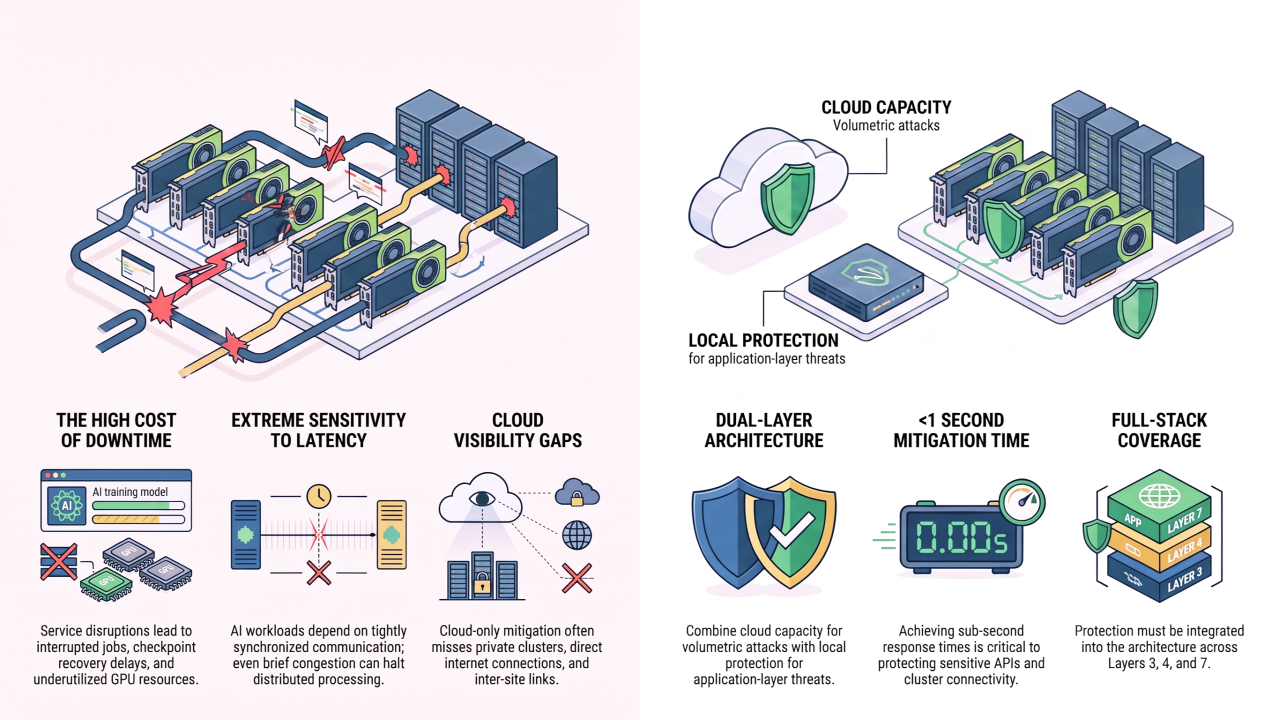
Distributed AI workloads depend on tightly synchronized communication among compute, networking and storage resources. Training, inference, data ingestion and checkpoint operations can all be affected by congestion, latency, packet loss or service disruption. When network services become unavailable, the consequences may include:
- Interrupted training jobs
- Checkpoint recovery events
- Underutilized GPU resources
- Delayed application and inference responses
- Wasted compute cycles and operational costs
AI infrastructure is built to maximize the utilization of expensive compute resources. Availability disruptions directly impact productivity, efficiency, and the return on those investments.
Why Cloud Mitigation Isn’t Enough
Cloud-delivered DDoS mitigation remains an important part of a defense-in-depth strategy, particularly for absorbing large volumetric attacks. However, it may not cover every AI environment, network path or service. Privately operated clusters, hybrid infrastructure, direct internet connections and inter-site links may require protection closer to the infrastructure they support.
The Case for Hybrid DDoS
A hybrid DDoS architecture addresses both requirements. Cloud-based capacity can absorb attacks that exceed local connectivity, while continuously active protection at or near the AI environment can identify and mitigate threats before they consume critical network or application resources.
Why Time-to-Mitigate Matters
For latency-sensitive AI infrastructure, time to mitigate matters. A time to mitigate of one second or less can significantly reduce the window in which malicious traffic can affect:
- APIs and application services
- Storage access and synchronization
- Management systems and orchestration platforms
- East-west traffic flows
- Cluster connectivity and training operations
This is particularly important for synchronized workloads, where even brief periods of congestion or packet loss can interrupt operations, delay recovery and reduce the utilization of expensive compute resources.
A DDoS attack does not need to cause an outage to be impactful. Even short disruptions can affect model training efficiency, inference performance, and overall infrastructure utilization.
DDoS Protection Should Be Part of the AI Architecture
DDoS protection should be treated as part of the AI infrastructure architecture rather than as a standalone network feature. The appropriate design should:
- Protect exposed services across Layers 3, 4, and 7
- Address volumetric, protocol, and application-layer attacks
- Protect cloud, colocation, and privately operated environments
- Reduce operational disruption from latency, packet loss, and congestion
- Support resilience without compromising performance
AI infrastructure is built to maximize the performance and utilization of high-value compute resources. Its availability strategy should be designed with the same level of care.
Interested in strengthening the resilience of your AI infrastructure? Speak with one of our specialists.

Raj Vadi
Senior Solutions Architect at Corero Network Security
FAQ
A DDoS attack does not need to cause an outage to be impactful. Even short disruptions can affect model training efficiency, inference performance, and overall infrastructure utilization.
Cloud-delivered DDoS mitigation remains an important part of a defense-in-depth strategy, particularly for absorbing large volumetric attacks. However, it may not cover every AI environment, network path, or service. Privately operated clusters, hybrid infrastructure, direct internet connections, and inter-site links may require protection closer to the infrastructure they support.
For latency-sensitive AI infrastructure, time to mitigate matters. A time to mitigate of one second or less can significantly reduce the window in which malicious traffic can affect APIs and application services, storage access and synchronization, management systems and orchestration platforms, east-west traffic flows, and cluster connectivity and training operations.
DDoS protection should be treated as part of the AI infrastructure architecture rather than as a standalone network feature.